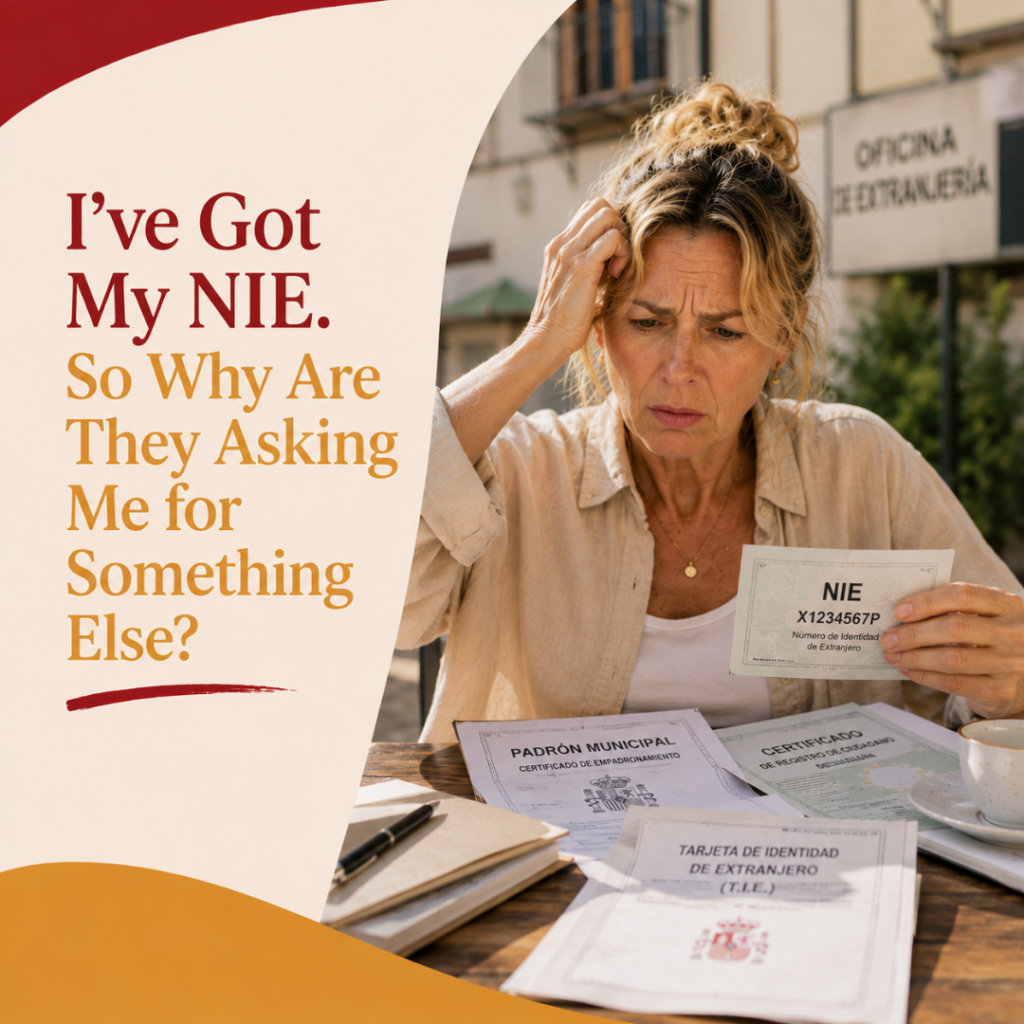
There’s a conversation we have quite regularly that starts with somebody sounding understandably confused.
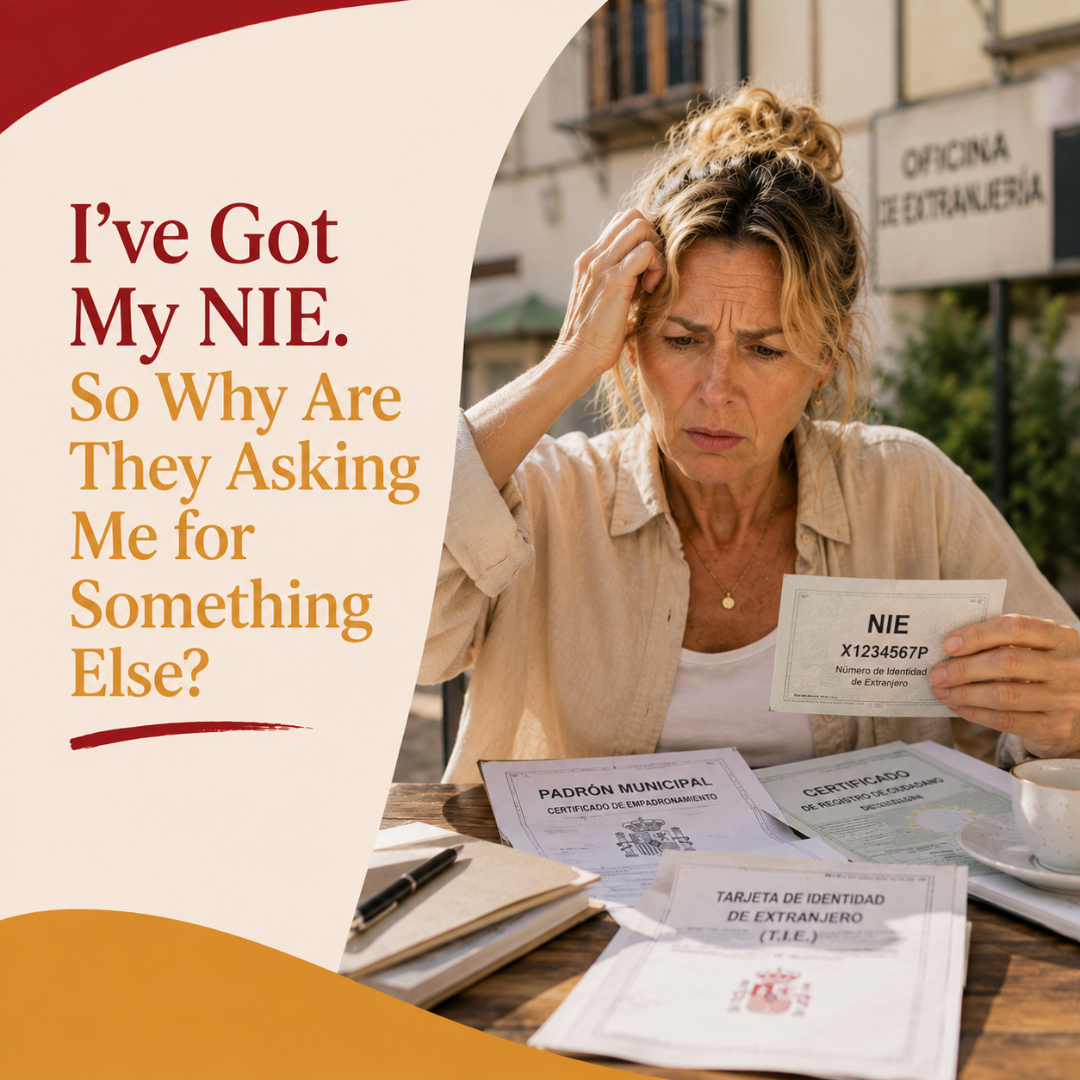
“But I’ve already got my NIE.”
They’ve been asked for another document, another certificate or another registration and can’t quite understand why. They went through the process of getting an NIE, they’ve got the piece of paper with the number on it, and as far as they understood, that was their Spanish identification sorted.
So why isn’t it enough?
The simple answer is that an NIE does one particular job. It gives you your identification number as a foreigner in Spain.
That number is unique to you and you’ll see it appear again and again as you deal with Spanish administration. But having an NIE doesn’t automatically prove everything else about your circumstances. It doesn’t, by itself, mean you’re registered as resident, registered with your Town Hall or set up to deal with government departments online.
And I think this is where much of the confusion begins.
The names don’t make it particularly easy
NIE. TIE. Padrón. Certificado de Registro. Cl@ve. Digital certificate.
If you’ve lived in Spain for a while, those words probably look perfectly ordinary now. At the beginning, they can sound like six different ways of describing roughly the same thing.
They aren’t.
We’ve spoken to plenty of people who have carefully kept every Spanish document they’ve ever received but still aren’t entirely sure which one proves what. That’s not because they’ve been careless. Nobody sat down at the beginning and explained how the pieces fit together.
An NIE identifies you within the Spanish system.
Depending on your nationality and circumstances, your residence position may involve different documentation. EU citizens intending to live in Spain for more than three months, for example, have a separate registration process in the Central Register of Foreigners. Other foreign residents may have a TIE, the physical identity card connected to their immigration/residence status.
Then there is the Padrón, which is a municipal registration with the Town Hall and has its own purpose.
And if you start dealing with Spanish administration online, you may come across Cl@ve or a digital certificate as ways of identifying yourself electronically.
They connect with one another, but they are not interchangeable.
“So which one do I actually need?”
This is usually the next question.
And unfortunately there isn’t one answer that works for everybody.
It depends on who you are, what you’re doing and what you’re being asked to prove.
Someone buying a holiday home but remaining non-resident has a very different situation from somebody moving permanently to Spain. An EU citizen settling here follows a different residence route from many non-EU citizens. A British person protected by the Withdrawal Agreement has another set of circumstances again.
Even something as ordinary as trying to complete an online administrative procedure can introduce another requirement you weren’t expecting.
This is why simply collecting a list of Spanish acronyms from the internet doesn’t necessarily make things clearer.
The useful question isn’t “Which Spanish documents exist?”
It’s:
“What am I trying to do next, and what will I need for that?”
Once you start there, the whole thing becomes considerably easier to understand.
Most people don’t need more paperwork. They need the right order.
One thing we’ve noticed over the years is that people often come to us with quite a lot of information already.
They’ve searched online. They’ve asked friends. They’ve downloaded forms. Somebody in a Facebook group has told them one thing and somebody else has told them the opposite.
Quite often there’s a perfectly good answer buried somewhere in all of it.
What they don’t have is the sequence.
Do I need the NIE first? Do I need to register as resident? Where does the Padrón fit in? Why am I being asked for this document when I already have that one? Can I do this online? Do I need an appointment?
That uncertainty is usually much more frustrating than the paperwork itself.
And it’s one of the reasons Solving Spain helps with NIEs, residency, TIEs, Padrón matters, appointments and the wider bureaucracy that comes with moving to and living in Spain.
Sometimes we deal with a process directly. Sometimes another professional needs to be involved. And sometimes the most useful thing we can do is simply look at where somebody is now and explain what comes next.
Don’t worry if you’ve been calling everything your NIE
People do this all the time.
We’ve had people send us photographs of documents saying, “Here’s my NIE,” when what they actually have in front of them is something slightly different. And we’ve had the opposite: somebody convinced they need to apply for a new NIE because an organisation has asked them for a document they don’t currently have.
Usually, the first thing to do isn’t another application.
It’s to establish what you already have.
If you’ve got a folder containing several official-looking Spanish documents and you’re no longer completely sure what each one does, that’s a perfectly reasonable place to start.
Take them out. Have a look. And before applying for something else, find out what the organisation asking you for it actually needs you to prove.
You may already have the answer.
And if you don’t, at least you’ll know which question you’re trying to solve.
Spanish bureaucracy makes more sense when you can see the next step
I don’t think anybody moves to Spain because they’re looking forward to administrative appointments.
But the paperwork becomes considerably less daunting once you understand the order of things.
Your NIE has a job.
Your residence documentation has a job.
Your Padrón has a job.
And the various ways of dealing with Spanish administration have jobs of their own.
You don’t need to become an expert in all of them.
You just need to know which one matters for what you’re trying to do next.
So if you’ve recently found yourself saying, “But I’ve already got my NIE…”, don’t feel you’ve missed something obvious. It’s one of those questions we hear more often than you might imagine.
Send us a WhatsApp, tell us what you’re trying to do and what paperwork you already have. We can help you work out where you are in the process and what the sensible next step is.
Sometimes that is much easier than starting another application because somebody told you that you need one.
WhatsApp: +34 695 398 679
Email: info@solvingspain.com
Website: www.solvingspain.com