There’s a moment during some property viewings when everybody seems to notice the same thing.
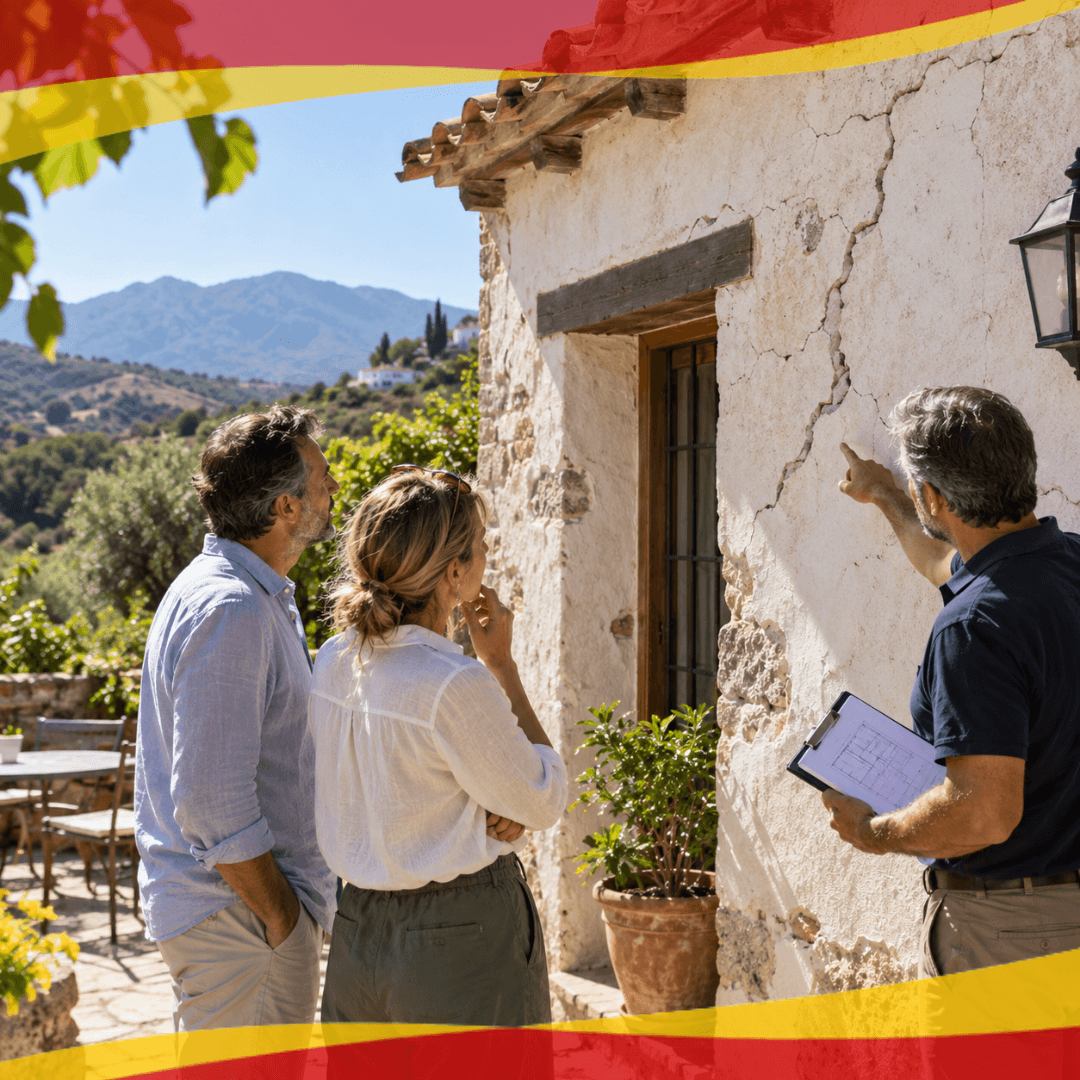
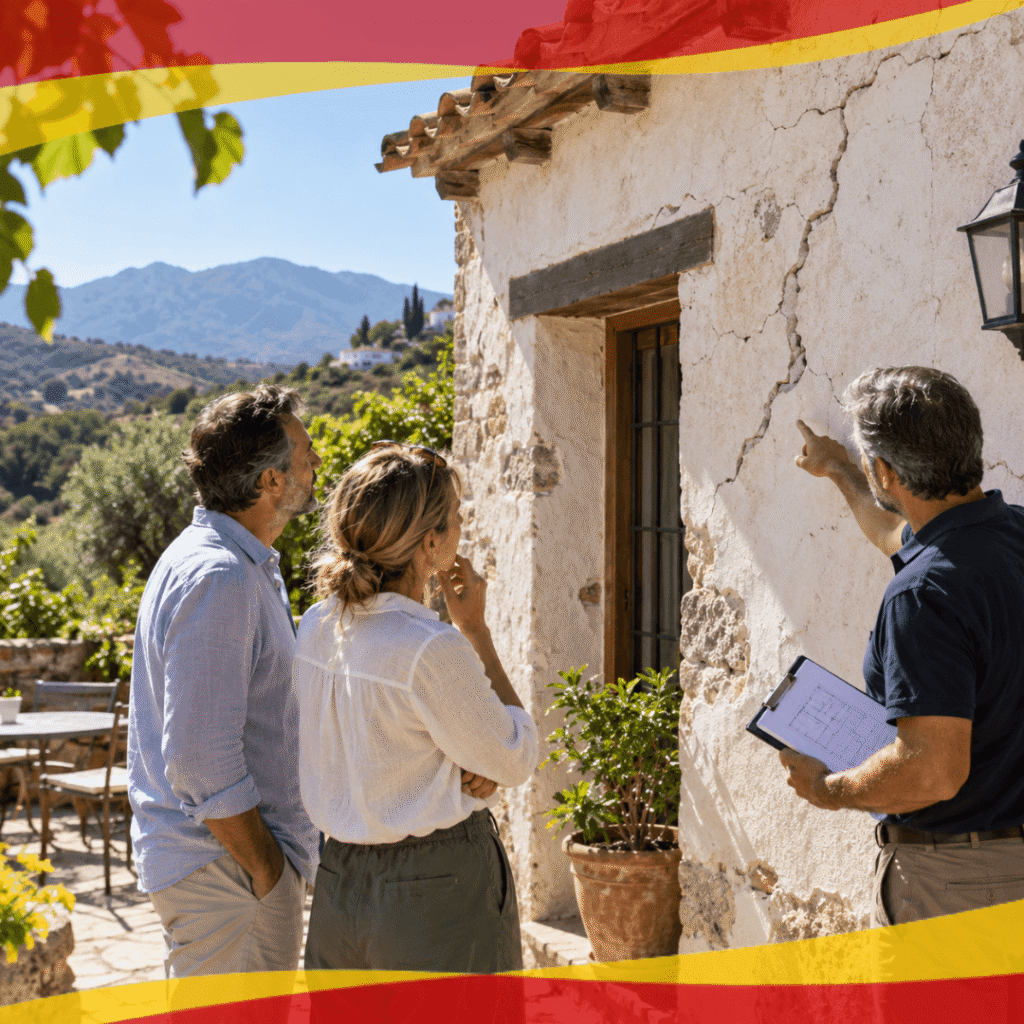
A crack.
Perhaps it runs above a doorway. Maybe there are a few fine lines around an old window, or a larger one stretching across part of a wall. Someone points at it, somebody else shrugs, and before long the conversation has moved on.
“It’s an old house. They all have a few cracks.”
Quite often, that may be true.
Older Spanish houses have lived a life. Walls have moved, plaster has aged, roofs have been repaired and previous owners have changed things over the years. Not every crack is a warning sign, and nobody wants to spend a property viewing treating every imperfection as though the house is about to fall down.
But that isn’t really the question.
The useful question is much simpler:
What does this particular crack tell us about this particular house?
That is where a property purchase survey starts becoming useful.
The things buyers notice aren’t always the things a surveyor notices
When you’re viewing a property you might be looking at the size of the rooms, the light, the view, whether your furniture will fit and how much work the kitchen needs.
That is completely normal. You’re trying to imagine living there.
A surveyor is looking at the same property rather differently.
They’re looking at the building itself. How it appears to have been constructed. Where water might be getting in. What the roof is doing. Whether cracks look superficial or deserve further attention. Drainage, damp, retaining walls, external areas, alterations, visible defects and anything else that may be relevant to the condition of the property.
Quite often, the thing that made the buyer nervous isn’t the thing that interests the surveyor most.
We’ve seen this more than once. A buyer becomes fixated on one very visible crack because it looks alarming, while the person inspecting the building is considerably more interested in something far less dramatic elsewhere.
That is useful in both directions.
A survey can uncover something you hadn’t noticed, but it can also stop you worrying unnecessarily about something that looked worse than it actually was.
Finding something doesn’t automatically mean walking away
I think this is one of the biggest misunderstandings around property surveys.
Some buyers are almost reluctant to have one because they worry it will turn the property they love into a long list of reasons not to buy it.
That isn’t really the point.
Older properties have issues. Newer properties can have issues too. A survey isn’t there to produce a perfect house, because very few houses would pass that test.
What it gives you is information.
Perhaps there’s maintenance you’ll need to budget for in the next few years. Maybe something needs a closer look from another specialist. There might be damp that needs dealing with, a roof area that has reached the stage where repairs should be expected, or a retaining wall that deserves more attention than you gave it during the viewing.
Sometimes something more significant appears.
But even then, the question isn’t automatically “Do we walk away?”
It might instead be:
What would it cost to deal with?
Do we need another professional to investigate it?
Does this change what we think the property is worth?
Are we still comfortable buying it, now that we understand it properly?
That is a much more useful conversation.
A property purchase survey should help you make a better decision. It shouldn’t make the decision for you.
Rural properties tend to give you more to think about
This is particularly relevant with rural houses, because the property you’re buying is often more than the four walls around the living room.
There may be land, retaining walls, terraces, outbuildings, pools, tracks, water arrangements or older structures that have been altered over time. The house itself may have grown in stages, with different parts dating from different periods.
And rural properties are often exactly the sort of homes people fall for quickly.
The view is wonderful. There are olive trees outside. There’s an old building you can already imagine turning into something useful. Perhaps there’s a pool and a terrace where you can see yourself sitting for years to come.
Those things matter. They are part of why you want the property.
But they can also make it easier to stop asking questions.
One of the patterns we’ve seen over the years is that excitement reduces curiosity. Once somebody can picture themselves living in the house, the mind very naturally starts moving towards how it will feel to own it rather than what still needs checking before they do.
That’s one of the reasons we like the survey stage.
It brings everybody back to the property that is actually standing there.
Not to spoil the excitement, but to make sure the excitement has something solid underneath it.
A survey is only one part of understanding what you’re buying
There is another distinction worth making.
A property survey and the legal or administrative checks around a purchase are not the same thing.
A surveyor is looking at the physical condition of the property. Separately, there may be questions about paperwork, planning, Catastro, Registro, boundaries, extensions, an AFO or what certain parts of a rural property are officially recognised as.
Sometimes those two worlds meet.
A surveyor might notice an area that looks as though it has been added later. That doesn’t automatically tell you the legal position of the extension, but it gives us another question to ask.
Or the paperwork might describe a property one way, while the physical building appears to tell a slightly different story.
That is where joining the dots matters.
At Solving Spain, our role is often to help buyers understand those different pieces together. The surveyor looks at the building. The lawyer deals with the legal side. An architect or another technical professional may need to become involved in particular cases.
Our job is not to pretend they all do the same thing.
It’s to make sure the buyer understands which question is being answered by whom, and whether there is another question still sitting between them. That reflects the wider Solving Spain position of helping buyers understand what needs to happen, when, and which professionals should be involved.
The house doesn’t need to be perfect
If you’re buying an older property in Spain, particularly a rural one, it is quite possible that a survey will find something.
That isn’t necessarily bad news.
Sometimes the most reassuring survey isn’t the one that says everything is perfect. It’s the one that explains what you’re looking at, separates the ordinary from the important and gives you a clearer idea of what owning that particular house is likely to involve.
You may still decide to buy it.
You may love it just as much afterwards.
The difference is that now you’re buying the house with your eyes open rather than hoping the things you noticed during the viewing probably don’t matter.
And if the survey does uncover something you weren’t expecting, there is still time to ask more questions before you commit yourself completely.
That is the point.
Not to find a reason to say no.
To make sure that when you say yes, you understand what you’re saying yes to.
If you’re looking at a property in Spain and you’re not sure what should be checked before you move forward, send us a WhatsApp and tell us where you are in the purchase. We can help you work out what needs looking at, arrange the right professional checks and make sure the different pieces of the purchase are being considered together.
WhatsApp: +34 695 398 679
Email: info@solvingspain.com
Website: www.solvingspain.com