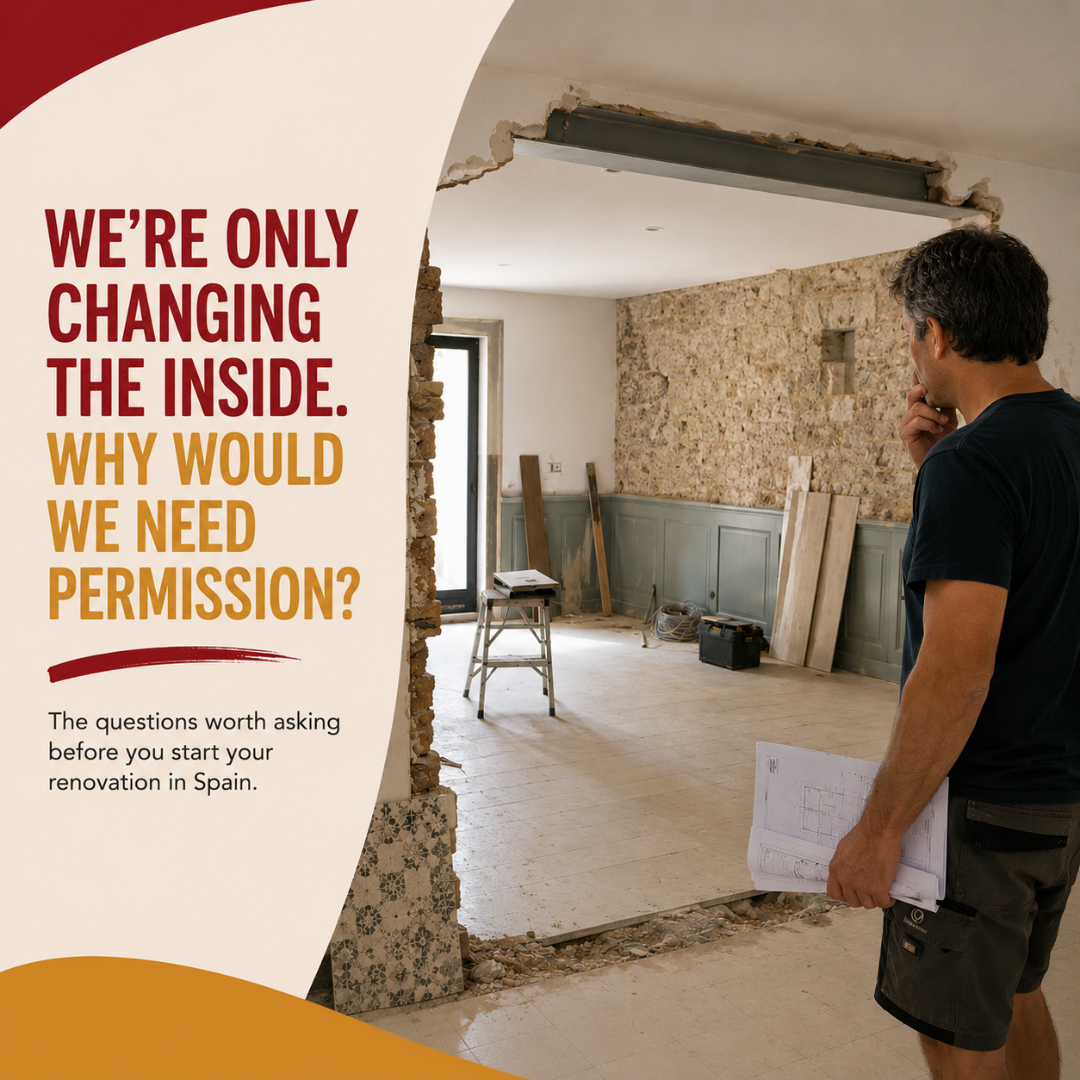
It often starts when somebody is already quite a long way into planning the finished room.
They’ve chosen the kitchen, decided which wall they’d like to move and talked to a builder about opening up the living room. Perhaps there’s a downstairs room they’ve never really used and they’ve finally worked out what they’d like to do with it. Then, somewhere in the conversation, somebody mentions permissions.
“But we’re only changing the inside. Why would we need permission?”
You can understand the thinking. You own the house, you’re not adding another floor or building an extension across the garden, and from the street nobody may even know you’ve done anything. It feels as though what happens inside your own four walls ought to be entirely up to you.
Sometimes the work is relatively straightforward. But “renovating the inside” can cover an enormous range of things, and that’s where it becomes worth asking a few questions before the builder arrives.
When a simple renovation stops being quite so simple
Two people can both tell us they’re “just doing some work on the house” and mean completely different things.
One might be replacing kitchen units, redecorating and changing some finishes. The other might be removing walls, altering openings, moving plumbing, changing windows or turning a previously unused part of the property into living accommodation.
To the owners, both are renovations. From a planning and technical point of view, they may be quite different.
Under the current Andalusian planning framework, some works can be dealt with through a declaración responsable, while other works can require a municipal licence or technical documentation. There are also circumstances in which very minor works may be treated more simply under municipal rules. The important thing is that the answer depends on the work itself, the property and where it is.
That’s why “it’s only inside” doesn’t really give us enough information to know what needs to happen.
We also hear another perfectly understandable version of this conversation: “The builder says it’s fine.”
And the builder may well be right. They may have done similar work dozens of times and know exactly how to build what you want. But knowing how to remove a wall and establishing what needs to happen before that wall is removed are not necessarily the same job.
That isn’t a criticism of builders. It’s simply about making sure the right person is answering the right question. Sometimes an architect or another technical professional needs to be involved. Sometimes there is something to deal with at the Town Hall. Sometimes the answer really is quite straightforward.
The useful bit is knowing which of those situations you have.
We tend to start one step earlier
When somebody talks to us about renovating a property, we’re obviously interested in what they want to create. But there’s another question we tend to ask first.
What exactly is there now?
What does the existing paperwork say about the property? Does what physically exists correspond with the documentation? Has something already been altered in the past? And what, precisely, are you proposing to change?
That can feel unnecessarily cautious when all you want is a bigger kitchen, but there’s a reason we ask.
One thing we’ve seen over the years is that renovation work sometimes brings an old property question to the surface. Perhaps something was altered years ago. Perhaps a part of the house isn’t described quite as everybody expected. Perhaps an area has always been used in a particular way and nobody has ever had a reason to look particularly closely at the paperwork.
The renovation hasn’t suddenly caused that situation. It has simply created the moment when somebody finally looks closely enough to notice it.
That matters because timing changes everything.
If the kitchen has already been ordered, the builder is booked for Monday and you’ve arranged somewhere else to stay while the work is happening, discovering that somebody needs to investigate the property isn’t particularly convenient. Even if the issue is perfectly solvable, you’re now trying to sort it out with money committed and a clock ticking.
Have exactly the same conversation a month or two earlier and it feels very different. There’s time to check the property, speak to an architect if one is needed, understand what the Town Hall requires and adjust the plans if something isn’t quite as straightforward as expected.
Checking first isn’t about finding reasons why you can’t renovate. It’s about knowing what you’re committing yourself to before you commit to it.
Rural properties are where we’d be particularly careful
This is especially relevant with rural houses.
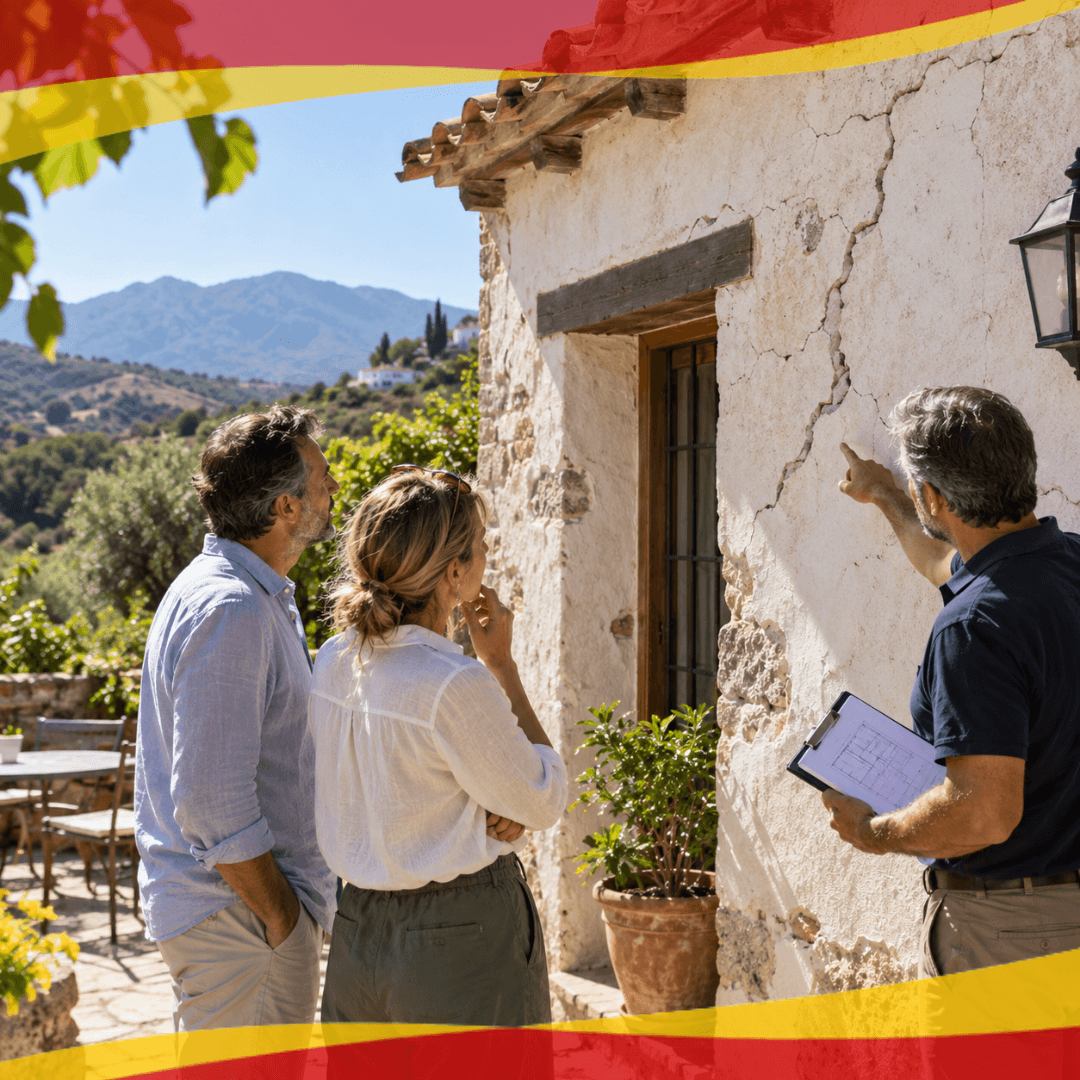
You can be standing in an old store room thinking it would make a wonderful bedroom, looking at a covered terrace imagining it enclosed, or wondering whether an existing outbuilding could finally be put to better use. Because the building is already there, it’s very easy to assume that changing it shouldn’t be particularly complicated.
But with rural property, what physically exists and what can now be altered, extended or used differently are not necessarily the same question.
The current Andalusian rules distinguish between different situations and types of work on existing buildings, so this is somewhere we would much rather look at the individual property than make assumptions.
“The previous owner did it.”
“It’s been like that for years.”
“The neighbour has one.”
All of those things may be true. None of them necessarily tells us what applies to your house and what you now want to do with it.
And this is often where Solving Spain fits into the picture.
We’re not architects, and if the question needs an architect, technical professional or legal adviser, that is who should answer it. What we often help with is working out which questions need answering in the first place, looking at the existing property paperwork, identifying what needs checking and then helping coordinate the appropriate professionals.
For somebody trying to renovate a property in another language and within a system they may never have dealt with before, that can be just as important as finding somebody who can actually do the building work.
Preferably while the wall is still standing
So, do you need permission to change the inside of your house in Spain?
Possibly. Depending on the work and the property, you may be dealing with a municipal licence, a declaración responsable, technical documentation or a much simpler situation.
I know “it depends” is one of those answers nobody particularly wants to hear. We hear that frustration quite often too. But what people really need after “it depends” is somebody to explain what it depends on.
What are you changing? What is the existing position of the property? Does the work affect the structure or alter the building in another significant way? Where is the property, and what does the relevant Town Hall require?
Once those questions are answered, the project often becomes much clearer.
So if you’re sitting at the kitchen table with sketches, photographs and a builder’s quote in front of you, that is actually a very good moment to ask.
Preferably while the wall is still standing.
If you’re thinking about renovating a property in Spain and you’re not sure where the paperwork, Town Hall or technical side fits into your plans, send us a WhatsApp and tell us what you’re hoping to do. We can help you work out what needs checking and, where necessary, coordinate the right professionals before the work begins.
WhatsApp: +34 695 398 679
Email: info@solvingspain.com
Website: www.solvingspain.com