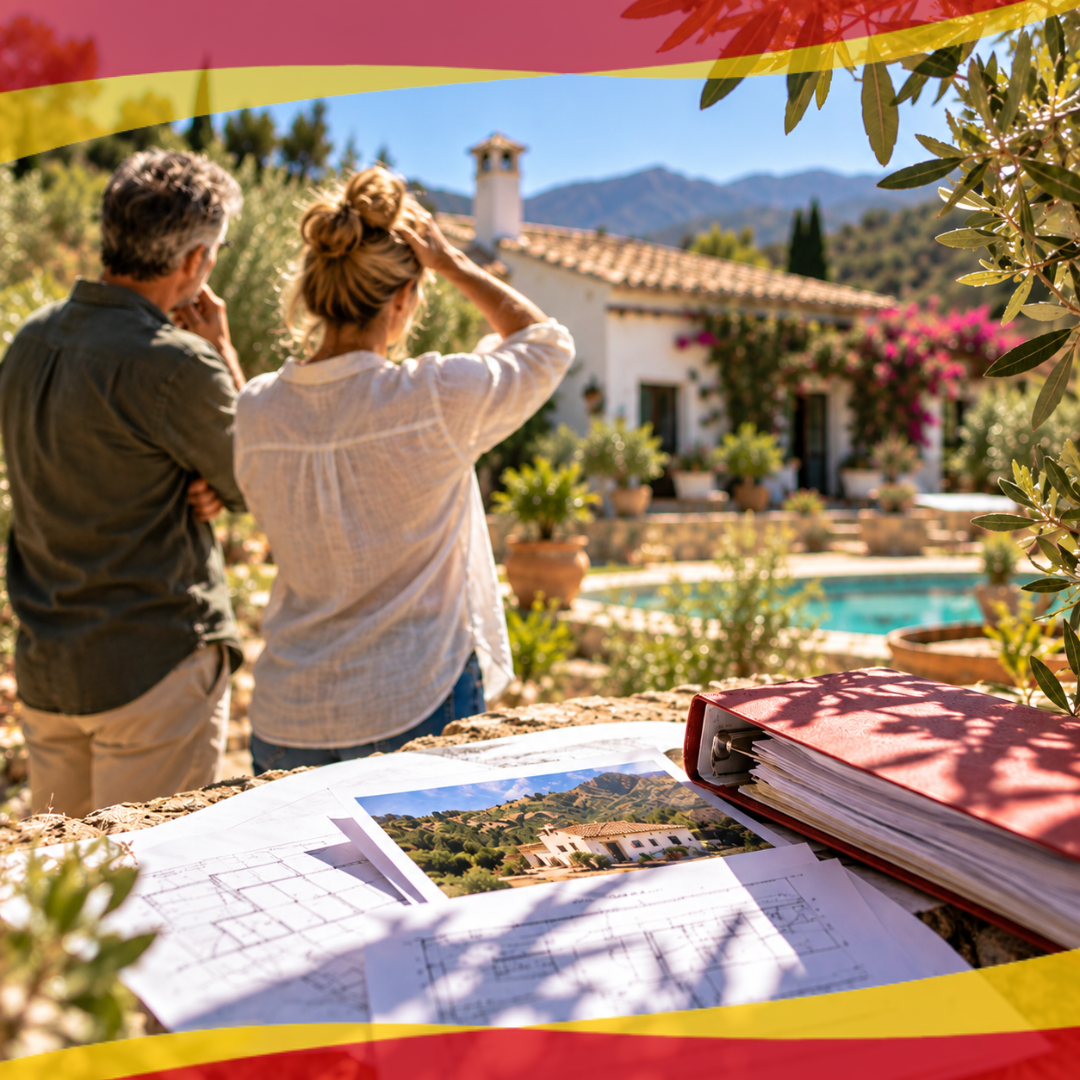
The first thing you notice is the light.
It comes through the doors onto the terrace, catches the white walls and makes the whole room feel calm. There are a few things you would change, of course. The kitchen isn’t quite your style, and you’d probably paint the second bedroom. But those are small details. You can already picture yourself living there.
Then you notice a faint mark in the corner of the ceiling.
The owner says it was from an old leak and the roof has since been repaired. That may be exactly what happened. But as you stand there looking at it, another question comes to mind: how would you know?
It is easy to fall in love with a property on a first viewing. The view, the layout and the feeling you get when you walk through the door all matter. But they don’t tell you everything about the building itself.
A viewing and a survey are different conversations
When you view a home, you are usually thinking about how it would work for you. Is there enough space? Could friends come to stay? Where would you put the dining table? Is the terrace sunny at the right time of day?
You might open a few cupboards, look under the kitchen sink or ask when the bathroom was last renovated. That is a sensible start, but a viewing is rarely enough time to understand the condition of a property properly.
A survey changes the focus. Instead of asking whether you can imagine living in the house, you are asking what you need to know before you decide to buy it.
What can be seen of the roof? Are there signs of damp or movement? What is the apparent condition of the windows, plumbing and electrics? Are there things that need attention soon, or features that may make the house uncomfortable or expensive to run?
The Junta de Andalucía advises buyers of second-hand homes to check their visible condition and, where necessary, consult a professional about the structure and installations. Junta de Andalucía
A survey doesn’t remove every uncertainty. It gives you a better basis for deciding what to do with the uncertainties you can identify.
“But the bank is sending someone”
If you are buying with a mortgage, the bank will usually require a valuation, known in Spain as a tasación.
That visit has a particular purpose: to establish a value for the property in connection with the mortgage. The Banco de España explains that the valuation helps the lender assess the property being offered as security for the loan. Cliente Bancario, Banco de España
A mortgage valuation may involve an inspection, but you should not assume that it gives you the same information as a survey commissioned to consider the property’s condition.
The questions are different. The bank needs a valuation for its lending decision. You may want to know whether there are visible signs of damp, what condition the roof appears to be in and which repairs might need attention.
If you have concerns about the building, ask what the valuation will cover and consider whether you also need a separate property survey.
The roof you can’t see from the terrace
Roofs are easy to forget about when you are standing inside a bright, freshly painted room.
On a traditional village house or cortijo, you might see the tiles from the street but have no clear idea of their condition. On an apartment, the roof may be part of the shared building, which brings its own questions about maintenance and responsibility.
A surveyor can look at the roof where it is visible and safely accessible, as well as looking for signs inside the property that may suggest a problem. That doesn’t mean they can see beneath every tile or predict exactly when a roof will need work.
If the roof is inaccessible or something raises concern, the sensible next step may be a closer inspection by an appropriate specialist. It is better to know that a question remains unanswered than to assume everything is fine because nothing obvious appeared during a viewing.
When a mark on the wall is more than a mark
A patch of discolouration can have several explanations. It might relate to an old leak that has been repaired. It might be condensation. It could suggest an ongoing issue that needs further investigation.
The mark itself does not tell you the whole story.
A freshly decorated home can also make it difficult to judge what happened in the past. That does not mean fresh paint is a warning sign; most sellers want their homes to look their best. It simply means you should not rely on appearance alone.
If a surveyor sees something that warrants attention, they may recommend monitoring it, asking for evidence of repairs or obtaining a more detailed assessment. The response depends on what can be observed and how much is known about the property.
For a buyer, the useful question is often not “Is there a mark?” but “What do I need to understand before I take responsibility for it?”
The things you’ll use every day
Some of the most practical questions have nothing to do with the feature that first attracted you to the house.
The windows might look attractive but let in draughts in winter. The property may be cool and comfortable on a spring viewing, yet difficult to heat once the evenings become colder. A hot-water system may work, but be nearing the point where you need to replace it.
The plumbing and electrics deserve attention too. A general visual inspection can identify apparent concerns, but it is not automatically the same as a full electrical test or an investigation of concealed pipework. If you need specialist testing, discuss that separately.
It helps to tell the surveyor how you intend to use the house. A property you visit for a few weeks in summer may present different practical priorities from one you intend to live in year-round.
For example, if you work from home, comfort through the seasons and the practical arrangement of rooms may matter as much as the terrace. If you are buying a rural property, you might want to ask about the visible condition of water storage, access and outbuildings too.
Old houses can be wonderful. They can also need understanding.
Many of the properties people fall in love with in Andalucía have been altered over time. A village house may have been extended upwards, a cortijo adapted for modern living, or a storage building converted into a room for guests.
That history can be part of a home’s character. It can also mean that different parts of the building were constructed at different times, using different materials and methods.
An older house may show signs of age without being a bad purchase. The challenge is understanding which features are part of its character, which require routine maintenance and which deserve further investigation.
The same is true of a newer property. A modern finish is reassuring to look at, but it does not answer every question about condition or future maintenance.
A survey is not there to tell you that every imperfection is a reason to walk away. It is there to help you understand what you are considering.
What a survey can—and can’t—tell you
A property survey can help you identify visible concerns, understand the apparent condition of accessible parts of the building and decide whether you need further advice. Depending on the service you choose, it can also help you consider urgent works and possible improvements.
But there are limits.
A surveyor cannot normally see through walls, lift every floor covering or dismantle parts of a house during a standard inspection. Furniture, locked rooms, inaccessible roofs and services that are switched off can all restrict what can be checked.
Nor is a physical survey automatically a legal or planning investigation. A building can appear sound but still raise questions about its planning status or how it is recorded. Equally, paperwork may look orderly while the property needs physical repairs.
Before booking, ask what is included, what cannot be inspected and whether you will receive verbal advice, a written report or both. If an issue needs a structural engineer, electrician, plumber or another specialist, that should be made clear.
When should you arrange one?
Ideally, arrange the survey before you become unconditionally committed to buying.
That gives you time to consider the findings, seek further advice if necessary and decide whether the property still works for you and your budget.
In practice, buyers are sometimes asked to sign a reservation agreement quickly. If that happens, speak to your legal adviser before signing or paying a deposit. Explain that you want a survey and discuss the agreement’s terms, deadlines and any protections that may be needed. Don’t assume you can recover a deposit simply because a survey later raises concerns; that depends on the agreement and the circumstances.
The purpose isn’t to slow everything down unnecessarily. It is to make sure that the decisions happen in an order that gives you a meaningful opportunity to act on what you find out.
What happens if the survey finds something?
First, take a breath and find out what the finding means.
A list of observations can look daunting when you first read it. Some items may be routine maintenance. Others may be improvements you can plan over time. A more serious concern might need a specialist inspection or a quotation before you decide what to do.
You may still love the house and feel comfortable proceeding. You might want to ask the seller for more information, discuss whether a repair can be carried out, or reconsider the price in light of the work. You may also decide that the property is not right for you.
The survey does not make that decision for you. It helps you make it with a clearer understanding of the property.
Which type of survey should you choose?
At Solving Spain, we work with an architect to offer two options:
- Verbal survey: €200 plus IVA. A practical discussion of the property’s condition and the architect’s observations.
- Written survey: €800 plus IVA. A written report for buyers who would like the findings documented in more detail.
The inspection can consider areas such as the structure, roof, windows, electrics, plumbing and energy-related features, as well as apparent urgent work and possible improvements. The precise scope and any limitations should be confirmed before booking, particularly if there are outbuildings, inaccessible areas or specific concerns you want addressed.
If you are unsure which option suits the property, tell us what you are buying and what you would like to understand. We can talk through the appropriate starting point.
You can still love the house
A survey doesn’t have to take the pleasure out of buying a property. In many cases, it makes it easier to enjoy the decision.
You may learn that the house is much as you expected, with a few ordinary jobs to plan for. You may discover something that changes your budget. Or you may find that the property needs more work than you are prepared to take on.
All three outcomes are useful to know before the house becomes yours.
The terrace can still be the place where you imagine your first long lunch. The survey simply helps you look at the roof above it too.
If you’ve found a property in Spain and would like to understand its condition before you commit, contact Solving Spain. We can help you arrange the right conversation with an architect.